
Do you have a project in mind?
Actualités > Cities’ Adaptation to Climate Change
Cities' Adaptation to Climate Change: A Challenge We Must Address Today
The urban sprawl of concrete, combined with global warming, has led to the emergence of new risks. Summer heat waves and flooding are now integral parts of the challenges facing local governments. How can we find solutions tohelp cities adapt to climate change? What role does urban planning play in building this resilience? Polymobyl has the answers.
What are the main climate-related risks in cities?
Before discussing adaptation, it is important to define the hazards facing these areas. There are two: urban heat islands and flooding.
Cities are mineral and man-made environments whose surfaces store heat during the day and release it at night. Vegetation is scarce, and global warming leads to early, prolonged, and intense heat waves. These various factors lead to the “urban heat island” (UHI) effect. This causes temperature differences of several degrees between city centers and their outskirts.
Concrete construction leads to a second adverse effect: soil sealing, which prevents rainwater from infiltrating naturally. During intense rainfall events—which are becoming increasingly frequent due to climate change—runoff causes rapid, localized flooding that is difficult to manage.
Adapting to climate change in cities therefore also involves ensuring the safety of the population.
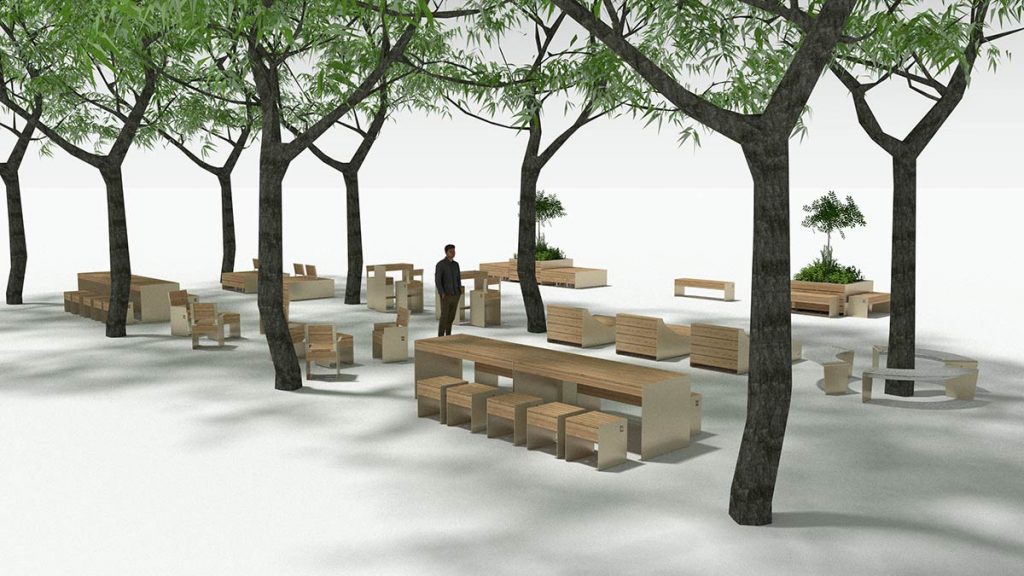
Solutions and Adapting to Change: What Tools Do Cities Have at Their Disposal?
Heat islands and flood risk share common solutions. These involve reorienting urban planning policies along three lines:
- reintroducing vegetation into cities;
- making the ground permeable;
- creating cool spaces.
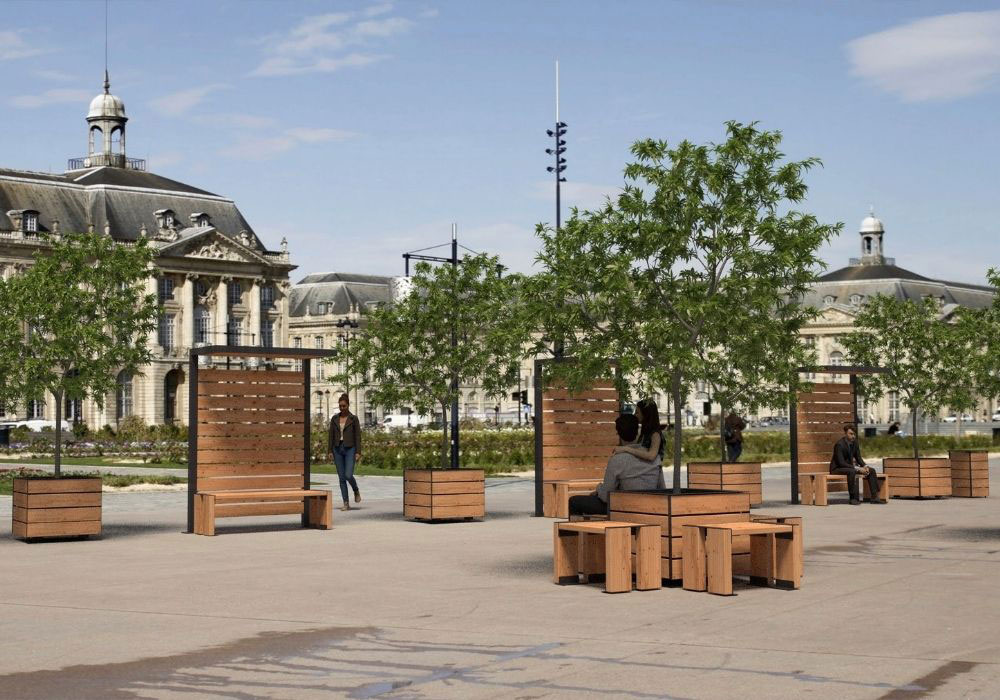
Urban greening is not limited to planting trees. Installing planters, green walls, green roofs, or pergolas covered with climbing plants are simple solutions that can be implemented in confined spaces without major construction work.
When combined with appropriate growing media, which help limit water runoff, these features also improve soil permeability.
What is a cooling island, and what role does it play?
As a direct response to the urban heat island effect, this design can incorporate several elements:
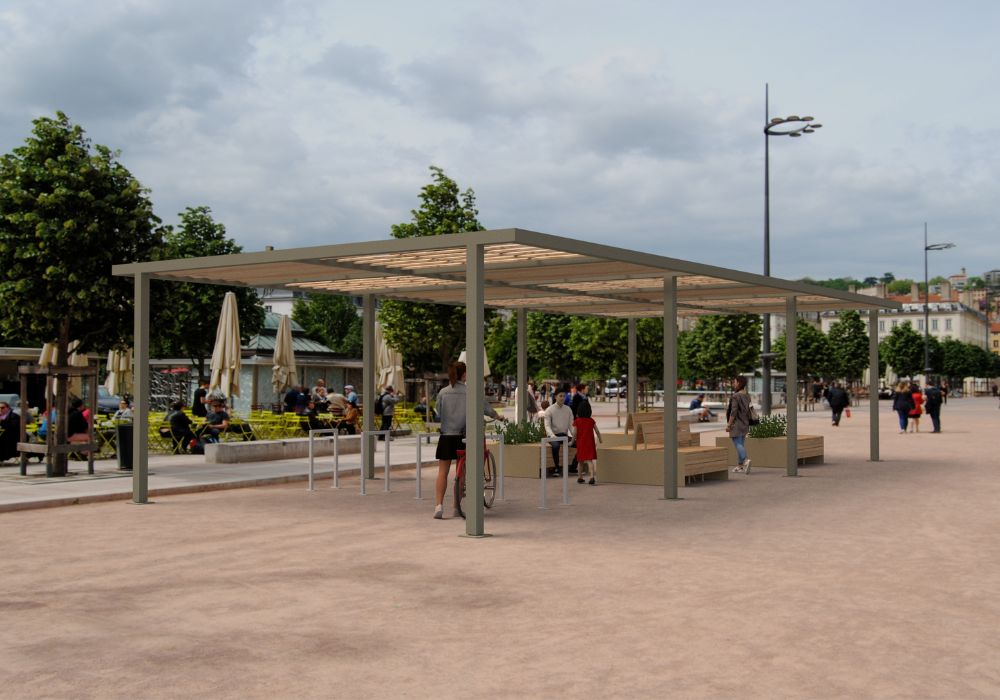
- shade structures to block direct sunlight: pergolas, awnings, shade sails, etc.
- climate-adapted vegetation: climbing plants, groundcover, hardy varieties, and even vegetable plants;
- planters and outdoor furniture made from materials that do not retain heat;
- a rainwater harvesting system;
- a misting system.
The cooling island significantly reduces the perceived temperature in the area without air conditioning or other energy-intensive equipment. It can be installed in a plaza, a forecourt, a schoolyard, or a green space…


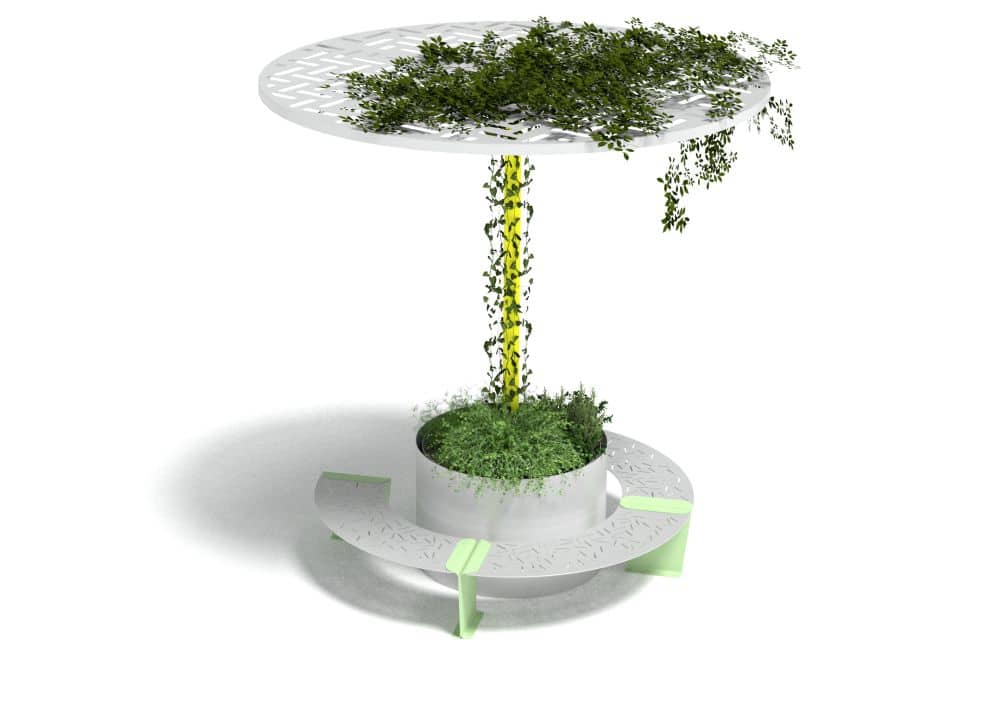

How Can Street Furniture Be Used to Adapt to Climate Change?
Most local governments in France now incorporate sustainable development and the ecological transition into their urban planning projects. For cities to be resilient in the face of climate change, they must address these challenges and develop innovative, eco-responsible solutions. It would, in fact, be inconsistent to reduce urban heat by using materials whose production exacerbates global climate disruption…
Polymobyl is fully aligned with this new approach to land-use planning. While “cool islands” do not replace large-scale renaturation projects, they do represent a quickly implementable means of improvement. As such, sustainable street furniture directly contributes tocities’ adaptation to climate change.
Polymobyl designs its products with sustainability and eco-design in mind:
- recyclable materials (wood, aluminum);
- sustainable raw materials (steel, Corten steel, Plexiglas);
- weather-resistant finishes (polyzinc treatment or hot-dip galvanization);
- custom designs for each site.
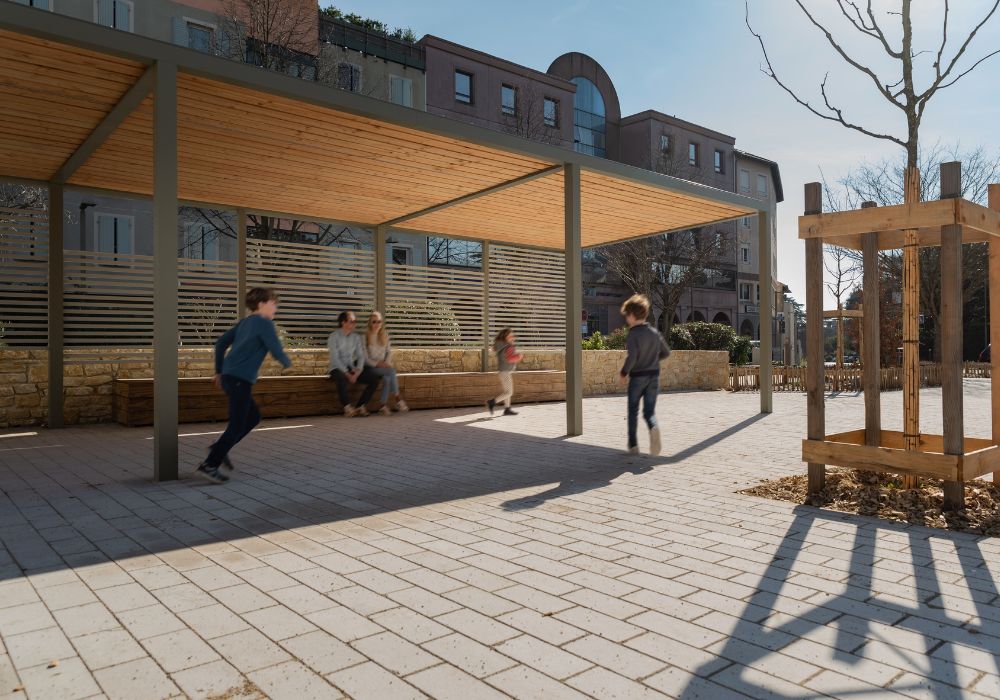
Climate adaptation in cities requires both local initiatives and national political will. Resilience is also built facility by facility, space by space. The urban pergola installed on Place de la Libération in Champagne-au-Mont-d’Or is a prime example of this.
Whether you’re a local government or a business, turn to Polymobyl for personalized support—from the initial assessment to the installation of your green shade structures. Contact us to discuss your future projects or call us at +33 (0)4 78 19 46 10.