


Discover our catalog

Greening Public Spaces: Challenges and Solutions for Local Governments

Our Catalog

According to a survey by the UNEP (National Union of Landscaping Companies), 80% of French people believe there isn’t enough greenery in cities. This figure clearly illustrates the urgency of the situation. In heavily built-up areas, urban heat islands cause nighttime temperatures to rise by several degrees. Conversely, the shade provided by a single tree is enough to significantly cool its immediate surroundings.

In light of the climate emergency and residents’ growing expectations, greening public spaces has become a priority for local governments. Given that large-scale renaturation projects are time-consuming and costly, there is a solution to address the acute shortage of vegetation in cities: green street furniture.

Why is it urgent to make cities greener?

Urban greening is one of the tools available to local governments to address three major challenges.

Global Warming and Quality of Life

Heat waves are more frequent, last longer, and bring record-breaking temperatures. Cities, with their high concentration of concrete, accumulate heat during the day and release it at night. The result: stifling nights and a rapid decline in comfort for city dwellers.

Greening urban spaces works on two levels:

  • Shade protects surfaces from direct sunlight.
  • Evapotranspiration cools the surrounding air.

Mature shade trees lower the perceived temperature by 3 to 5 °C in their immediate vicinity. On a smaller scale, a planted window box or a green pergola creates a more temperate microclimate.

Biodiversity and Public Health

Bringing greenery to urban spaces also helps improve air quality in cities. In fact, vegetation filters fine particulate matter. It also provides a habitat for pollinating insects, which are essential to the balance of ecosystems, both in cities and elsewhere.

Bringing greenery back to public spaces improves well-being, reduces stress, and enhances the appeal of neighborhoods… A green setting creates a space where people want to linger. Community gardens add a human and social dimension to the project.

Ecological Transition and Regulatory Challenges

The Climate and Resilience Act and the Net Zero Land-Use Change (ZAN) goal require local governments to reevaluate their land-use planning practices. Creating new green spaces on the outskirts is no longer always possible or desirable. However, greening existing public spaces is a viable solution.

There is no need to convert new land to non-natural uses: it is enough to transform what already exists. Green street furniture effectively contributes to this without altering the land use structure of the space. Local governments can thus meet their regulatory obligations without undertaking large-scale urban planning projects.

What are some ways to restore vegetation in a public space?

Faced with this issue, cities have two options: large-scale renaturation projects and green street furniture.

The first solution involves lengthy and costly work: removing the existing surface, conducting soil studies, civil engineering, and more. The result is effective, but the process is restrictive.

The second option makes it possible to introduce greenery into any public space without significant constraints. Installing a planter, a green pergola, or a living wall requires only minimal work and a modest investment. Quick to deploy and flexible, this type of project is well-suited to confined spaces such as pedestrian alleys, plazas, and courtyards.

These two approaches to urban greening are perfectly complementary.

How can we bring greenery to urban spaces without major structural work?

Two types of equipment are particularly well-suited to meeting this challenge facing local governments.

Urban Planters

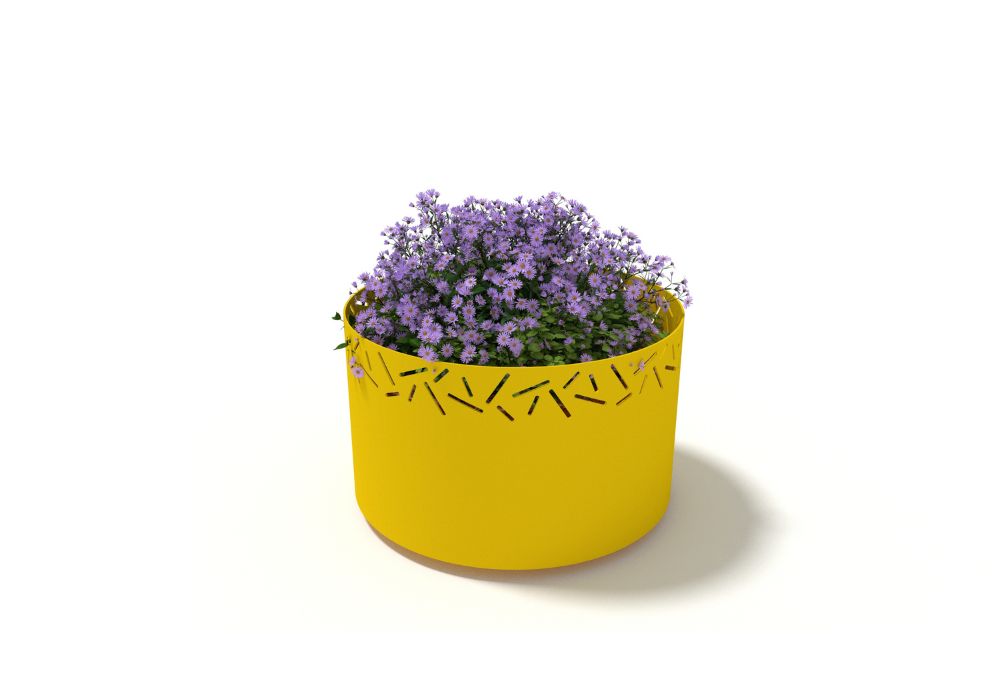
This is the most accessible way to incorporate greenery into a concrete space. Polymobyl offers several product lines tailored to the project’s needs and aesthetic context.

The NUT, CUB, and LUD planters are available in several colors. They can be used on their own to add flowers to a space, or placed against shelters to incorporate greenery into an existing structure. A weighted planter, meanwhile, adds a touch of greenery to a shelter while ensuring its stability without needing to be anchored to the ground.

Explore our full selection of planters to design your outdoor space.

Green pergolas

A shade structure or pergola can be adapted to support climbing plants. Over time, it transforms into a veritable canopy of greenery.

This solution combines immediate shade provided by the structure with gradual cooling thanks to the vegetation covering it. The CUB pergola, for example, can be delivered with a louvered roof or with a trellis to allow for vegetation growth. A watertight roof is available upon request. This structure is ideal for creating urban green spaces in schoolyards, pedestrian plazas, or eco-neighborhoods.

Can these solutions be combined?

In fact, it is highly recommended as a way to create a cohesive whole and bring nature back into the city. A green pergola, planters, a living wall, and coordinating seating elements can permanently transform the use of a public space and the experience of its users.

Why Choose a Custom Approach for Your Green Street Furniture?

A standard product rarely meets the actual constraints of a site. That’s why Polymobyl offers an approach that’s tailored to the realities on the ground.

Every project begins with a preliminary assessment. Polymobyl visits the site to evaluate its exposure, soil conditions, pedestrian traffic, utility lines, and aesthetic considerations. This assessment helps identify priority areas for landscaping and select and size the appropriate solutions.

Next comes the custom design: dimensions, RAL colors, wood species, partition types, planter configurations, pergola orientations… Each element must blend in harmoniously and meet the project’s environmental objectives. Local governments can align their outdoor furniture with their brand guidelines, landscape design plans, or biodiversity action plans.

A single point of contact guides the project, presenting 2D and 3D visuals and seeking approval at each stage. For installation anywhere in France, Polymobyl offers two options: a turnkey service or delivery as a kit with assembly assistance.

Bringing greenery to urban spaces is no longer just an option. It is a climatic, regulatory, and civic imperative. Polymobyl’s green urban furniture provides a concrete, immediately deployable, and sustainable solution. This credible alternative complements large-scale renaturation projects.

Project leaders, contact Polymobyl to receive an assessment of your space and a personalized quote.

Scroll to Top